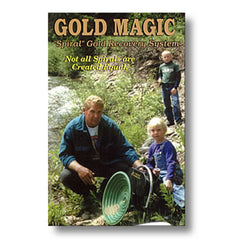
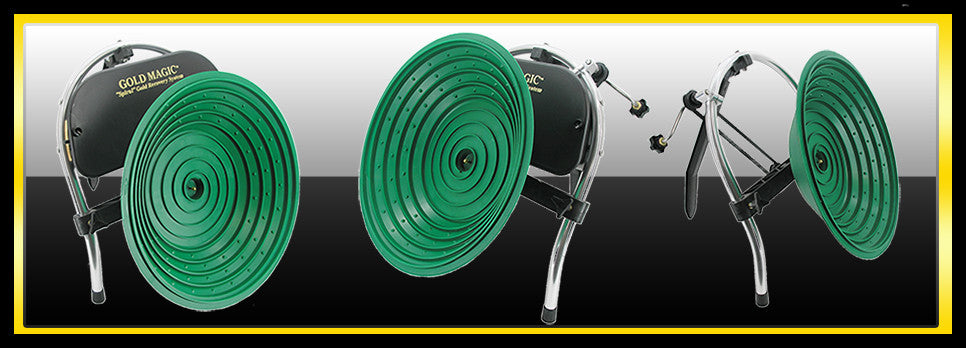

Finding GoldThe old adage that "Gold is where you find it" is not necessarily true. Prospecting in the better known gold bearing regions will immediately improve your chances of finding gold. Gold is where others have found it and you have come up with a better method of recovering gold. That better method is your Gold MagicŪ. Your Gold MagicŪ spiral recovery system is light weight and folds to a small size for easy storage. Always keep your Gold MagicŪ with you while traveling in your car, RV, boat or airplane, for opportunities come when you least expect them. RIVERS & STREAMS
![]() LAKES
Prospect thoroughly where the stream enters the lake. If you find any color at the mouth of a stream or dry wash, chances are there is more gold further up the stream. Here is where the wet and dry capabilities of your Gold MagicŪ shows its value. You can work wet in the lake or streams and in a few minutes work dry without changing equipment. DESERTS AND DRYWASHES
Even though these areas are dry most of the time they do quite often receive torrents of rain which cause flash floods, developing into rapid rivers which easily erodes the soil along the river banks. When these rivers recede, the dry river bed is commonly referred to as a "dry wash". Looking for gold in a dry wash is a lot like looking for gold in a river except you have better access to all areas of the dry wash. Look for bedrock and crevices in the bedrock. Remember gold only moves during flood stages and tumbles along the bottom because of its weight. In doing so the gold will lodge on or in cracks of the bedrock. Also look for large boulders that may be firmly anchored in the wash. When the flow of water is disrupted around the boulder, the gold will settle at this spot. A common practice is to place a cargo strap around a boulder and roll it over with the use of a come-along or winch on a 4X4 vehicle. Once the boulder has been moved you can process the material that was around and under the rock. If you can't move a particular rock, be sure to get at the material around its edges. A dry wash may have 10'-20' high sidewalls. Explore these walls for veins of black sand and crevices where gold may have lodged. WARNING: Always use caution when moving large rocks or boulders. ![]() CULVERTS AND GOLD
Also check the area to the right, left and below the entry of the culvert. A wide flow will strike the culvert abutments and cause the gold to drop at the mouth. GROUND HOGS AND GOLD
These ground hogs are little gold miners; process what they have piled up. If you find some gold, keep processing until you're done then cave in the hole. The next time you are by, there will likely be a entirely new mound to process. It is common knowledge that the largest strike ever discovered was the Comstock Lode and it was a result of ground hogs digging. TAILINGS FROM OLD MINES
You probably already know where there is an abandoned mine. You can recognize them by the tailings lying on the hillside. You can check with the Bureau of Land Management or Bureau of Mines for more information regarding mines. WARNING: Mine shafts are dangerous! Stay away from any openings. These tailings can be processed wet or dry just as you find them. If you find a good producer you may want re-establish the claim. |